The Ultimate Beginner’s Guide to Home Workouts [2026]
The ultimate beginner guide to home workouts. No gym needed - just bodyweight exercises you can do in your bedroom. Start your fitness journey…

The Ultimate Beginner’s Guide to Home Workouts
You can build real strength and fitness at home with zero equipment. This beginner home workout plan gives you everything you need: six foundational exercises with exact form cues, a complete 4-week progression, and small-space tips for apartments. According to the WHO physical activity guidelines, adults need at least 150 minutes of moderate activity per week — and three 20-minute home sessions get you most of the way there.
No gym membership. No commute. No waiting for machines. Just you, a 1.2m x 1.2m patch of floor, and 20 to 30 minutes, three days a week.
Why Home Workouts Work for Beginners
- Zero barrier to entry — no membership fees, no travel time, no intimidation
- Bodyweight builds real strength — research shows bodyweight training builds muscle comparably to weights when you progress consistently
- Privacy accelerates learning — practice form without feeling watched
- Short sessions stick — 20-minute workouts done consistently beat 60-minute workouts done rarely
- Small spaces are enough — every move below fits in a 1.2m x 1.2m area beside your bed
What You Need to Start ($0 Setup)
You need less than you think. Here is the complete equipment list:
- Floor space — 1.2m x 1.2m of clear floor (bedroom corner, hallway, living room)
- A sturdy chair — for squats, step-ups, and incline push-ups
- A wall or doorframe — for wall push-ups and rows
- A towel or mat — comfort for floor work, plus noise dampening for apartments
- Water — keep a bottle within arm’s reach
That is it. Optional later: a resistance band or a pair of light dumbbells. But weeks 1 to 4 of this plan require nothing but your body.

Apartment-Friendly Promise
Every exercise in this guide is quiet and low-impact. No jumping, no thuds, no angry neighbors. Train barefoot on a mat or towel to stay silent and improve balance at the same time.
The 6 Foundational Moves (With Exact Form Cues)
Every effective program is built from basic movement patterns: squat, push, pull, hinge, and core. Master the bodyweight version of each and you own a foundation that transfers to any future training. Form first, always — quality reps build strength, sloppy reps build injuries.
1. Bodyweight Squat
How to do it: Stand with feet shoulder-width apart, toes slightly out. Push your hips back as if sitting into an invisible chair. Keep your chest lifted and spine neutral. Lower until your thighs are parallel to the floor. Drive through your heels to stand.
Common mistakes: knees caving inward, heels lifting off the floor, chest collapsing forward.
Three easier options: wall-supported quarter squats, chair sit-to-stands, slow assisted squats holding a countertop.
2. Push-Up
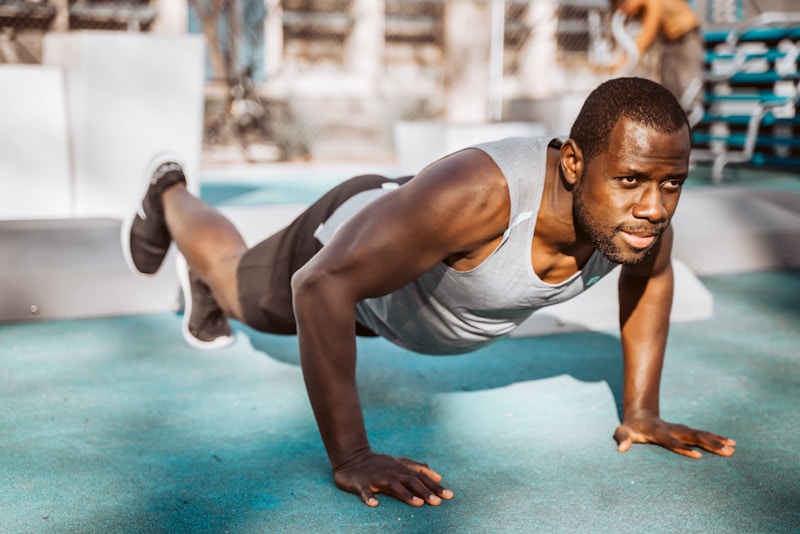
How to do it: Start in a high plank with hands slightly wider than shoulders. Brace your core and squeeze your glutes so your body forms one straight line. Bend your elbows to roughly 45 degrees and lower your chest to within a fist of the floor. Push the floor away to return.
Common mistakes: elbows flared to 90 degrees, sagging hips, head jutting forward.
Three easier options: wall push-ups, incline push-ups on a countertop, knee push-ups. For the full progression, see our push-up beginner guide.
3. Glute Bridge
How to do it: Lie on your back with knees bent and feet flat, hip-width apart. Press through your heels and lift your hips until your body forms a straight line from shoulders to knees. Squeeze your glutes hard for one second at the top. Lower slowly.
Common mistakes: arching the lower back instead of extending the hips, feet too far from the body.
Three easier options: shorter holds with fewer reps, feet-elevated bridge on a low step later, single-leg bridge when two legs feel easy.
4. Plank
How to do it: Rest on your forearms with elbows under shoulders. Extend your legs back and balance on your toes. Create one straight line from head to heels. Pull your belly button toward your spine and breathe steadily. Hold 20 to 30 seconds.
Common mistakes: hips sagging toward the floor, butt piked in the air, holding your breath.
Three easier options: knee plank, incline plank with hands on a chair, 10-second holds with full rest between.
5. Reverse Lunge
How to do it: Stand tall with hands on hips. Step one foot straight back and lower until both knees bend to roughly 90 degrees. Keep your torso upright and front knee tracking over your toes. Push through the front heel to return. Alternate legs.
Common mistakes: leaning the torso forward, front knee collapsing inward, steps too short.
Three easier options: stationary split stance with no stepping, holding a chair for balance, shorter steps with shallow depth.
6. Dead Bug
How to do it: Lie on your back with arms pointing at the ceiling and knees bent at 90 degrees. Press your lower back into the floor. Slowly extend your right arm overhead while straightening your left leg, without letting your back arch. Return and switch sides.
Common mistakes: lower back peeling off the floor, moving too fast, holding your breath.
Three easier options: arms only (legs stay still), legs only (arms stay still), smaller range of motion.
Your 4-Week Beginner Home Workout Plan
Train three days per week with at least one rest day between sessions — for example Monday, Wednesday, Friday. Alternate Workout A and Workout B. Each session takes 20 to 30 minutes including warm-up. This is the same alternating structure used by leading beginner programs because it balances every muscle group with built-in recovery.
| Workout A | Workout B | |
|---|---|---|
| Lower | Bodyweight squats — 2 x 10 | Reverse lunges — 2 x 8 per leg |
| Push | Incline push-ups — 2 x 8 | Wall push-ups — 2 x 12 |
| Hinge | Glute bridges — 2 x 12 | Wall sit — 2 x 20 sec |
| Core | Plank — 2 x 20 sec | Dead bug — 2 x 8 per side |
| Finisher | March in place — 2 min | Step-ups on stairs — 2 min |
How the Four Weeks Progress
The single most important principle is progressive overload — asking your body to do a little more each week. No weights required: add reps, add a set, or slow the tempo.
| Week | Sets | Focus |
|---|---|---|
| Week 1 | 2 sets | Learn the movements, stay well within your limits |
| Week 2 | 2 sets | Add 2 reps to every exercise |
| Week 3 | 3 sets | Add a third set, hold planks 10 seconds longer |
| Week 4 | 3 sets | Slow each rep down (3 seconds lowering) for more challenge |
How to Warm Up and Cool Down (5 Minutes Each)
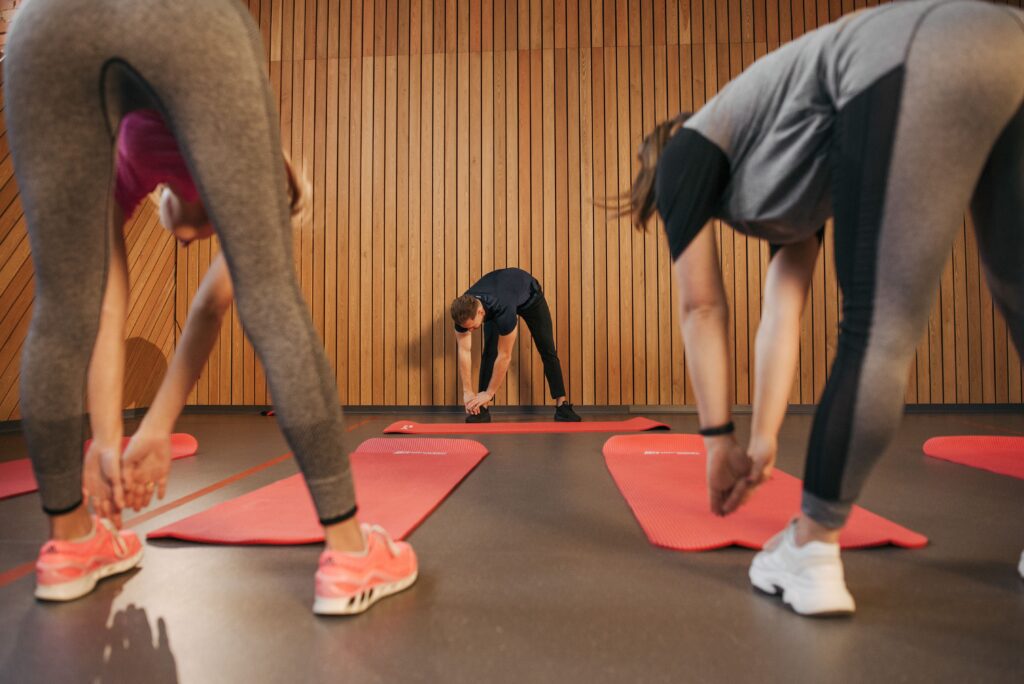
Never skip the warm-up. Five minutes of easy movement lowers injury risk and makes the workout feel dramatically better. Try this sequence before every session:
- March in place — 1 minute, swing your arms naturally
- Arm circles — 30 seconds forward, 30 seconds backward
- Bodyweight squats (easy) — 10 slow reps, half depth is fine
- Hip circles — 30 seconds each direction, hands on hips
- Inchworm walkouts — 5 slow reps, bend knees as needed
After training, cool down for 5 minutes: walk slowly around your room, then hold each stretch for 30 seconds — standing quad stretch per leg, doorway chest stretch, seated spinal twist per side, and child’s pose. Breathe slowly throughout.
What to Eat to Support Your Workouts
You do not need a special diet to start. Two simple rules cover 90 percent of beginner nutrition:
- Eat enough protein — aim for eggs, beans, lentils, chicken, fish, or Greek yogurt at each meal to repair muscle
- Fuel before, recover after — a banana or toast 30 to 60 minutes before training, and a balanced meal within a couple of hours after
For specifics, read our pre-workout nutrition guide and try the high-energy breakfasts under $3 for cheap morning fuel. The CDC adult activity guidelines pair 150 weekly minutes of activity with balanced eating for the best results.
5 Beginner Mistakes to Avoid
- Doing too much, too soon — soreness lasting more than 2 to 3 days means you overdid it; start conservative
- Skipping the warm-up — cold muscles and stiff joints invite injury and make everything feel harder
- Ignoring rest days — muscle is built during recovery, not during the workout itself
- Chasing variety over consistency — repeating the same moves is how you measure progress; save novelty for week 5
- Sacrificing form for reps — stop the set when form breaks; film yourself or use a mirror to check alignment
“Expect to feel different before you look different. Most beginners notice better energy, sleep, and mood in weeks 1 to 2 — visible strength gains follow in weeks 2 to 4.”
How to Track Progress (Without Overthinking)
Write down your reps, sets, and hold times after every session — a notebook or phone note is enough. Progress looks like this:
- Week 1 to 2 — same exercises feel easier, less soreness
- Week 2 to 4 — more reps, longer plank holds, better balance
- Beyond — clothes fit differently, stairs feel easy, energy lasts all day
Want to make tracking automatic? Our free fitness habit tracker builds workout streaks so you never break the chain. Pair it with our free workout timer to pace your sets and rests without watching the clock.
What Comes After Week 4?
Repeat the plan with harder variations: standard push-ups instead of incline, Bulgarian split squats instead of reverse lunges, single-leg glute bridges, and 45-second planks. When bodyweight stops challenging you, add one pair of light dumbbells or a resistance band. For your next structured challenge, follow our 7-day beginner workout plan or explore the full roadmap in our ultimate beginner fitness guide.
Frequently Asked Questions
Key Takeaways
- Three 20 to 30 minute sessions per week is enough to transform beginner fitness
- Six foundational moves — squat, push-up, glute bridge, plank, reverse lunge, dead bug — cover the whole body
- Progress weekly: more reps, an extra set, then slower tempos
- Zero equipment and 1.2m x 1.2m of floor is all you need for weeks 1 to 4
- Track reps, protect rest days, and fuel with protein plus simple pre-workout snacks
Start today — not Monday. Do Workout A right now with our free workout timer, then log your first streak in the fitness habit tracker.
Keep going: 7-Day Beginner Workout Plan | 5 Bodyweight Exercises | Ultimate Beginner Fitness Guide
RBTF Tip 1.2m × 1.2m is enough. Start with 5 minutes, keep the streak, and let small wins compound.

Your RBTF Coach
Rebyte.Talk · RBTF Coach
Helping beginners build 5-min habits in small spaces. No gym, no expensive gear — just consistent small wins.
More guides